
By Paulo Santos, CEO of Hosting Marketers
For years, businesses approached SEO as a game of keywords and backlinks. You researched a phrase, sprinkled it across your site, added some links, and if you played the game well, your website climbed to page one. Those days are finished.
A new CEO has taken over search, and that CEO is Google’s AI.
What changed in SEO?
Ten years ago, SEO worked like filling out a form. If you put the right words in the right boxes, your site was rewarded with visibility.
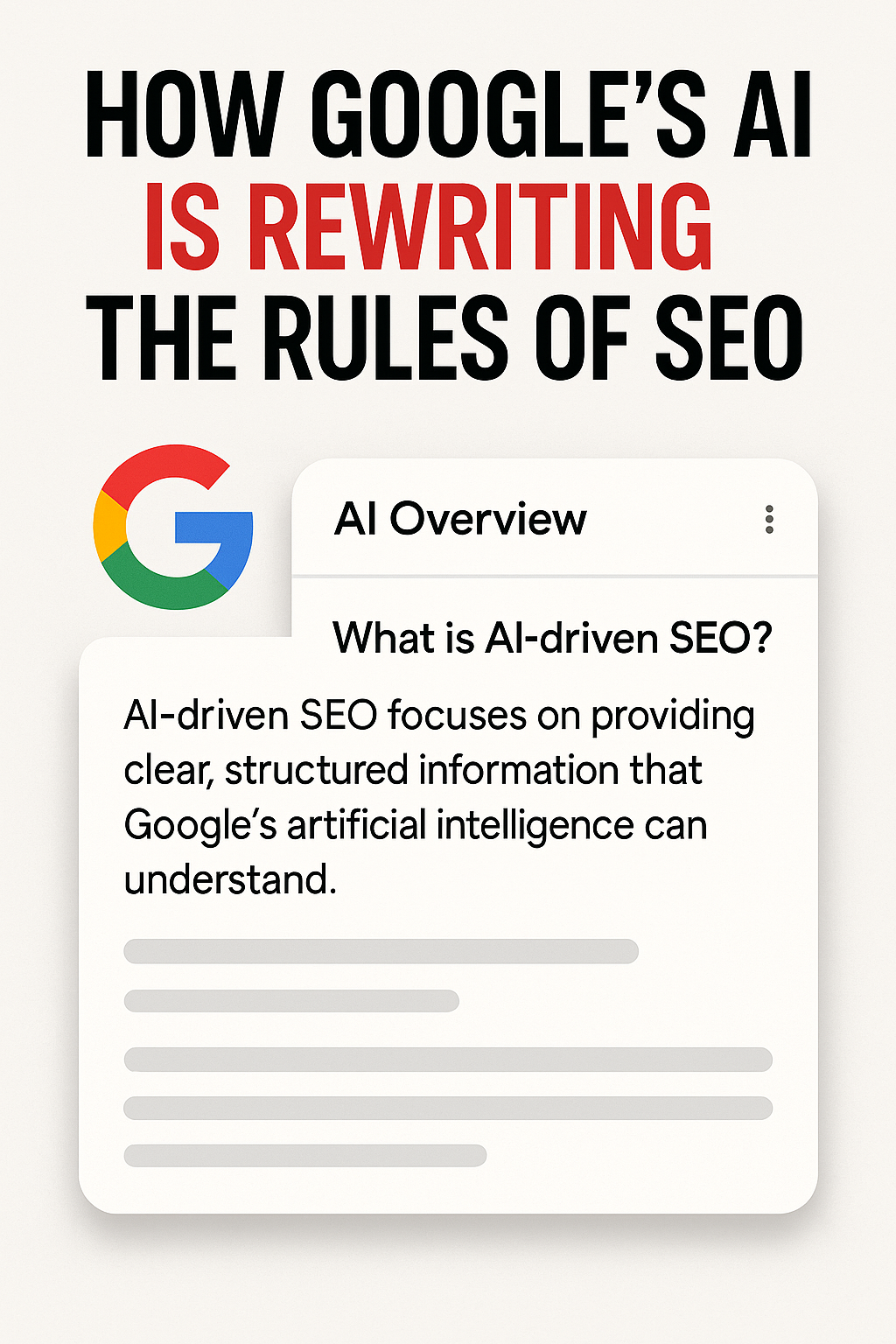
Today, Google has rolled out AI-driven results, called Search Generative Experience (SGE), which provide summaries directly at the top of the page. Instead of offering a list of links, Google’s AI reads, understands, and decides which sites are worth featuring in the answer box.
That means the rules of the game have changed. It’s not enough to be “on page one.” If Google’s AI doesn’t choose your content for its summary, your competitors will take the attention, and the clicks.
From keywords to concepts
The biggest shift is that SEO is no longer about matching keywords. Google’s AI doesn’t just read strings of text. It interprets concepts, entities, and intent.
- Old SEO: “How many times can I use the phrase ‘mobile app development’?”
- New SEO: “Does my page demonstrate expertise, explain the process, and answer the real questions clients ask about mobile app development?”
For example, if someone searches best mobile app development company, Google’s AI isn’t looking for the site that repeats the keyword the most. It looks for the site that has clear answers, structured information, and evidence of authority.
Why structure and schema matter
This is where many websites fail. Google’s AI can only feature your site if it can understand it. That means:
- Clear topics – Each page should cover one subject in depth. Use a pillar-cluster model: one main page as the “pillar” and supporting pages answering related questions.
- Well-organized content – Use proper headings (H1, H2, H3), short paragraphs, and logical sections. A human should read it easily, and AI should be able to map the hierarchy.
- Schema markup – This is like giving Google a cheat sheet. With schema, you can tell search engines, This is a service. This is a product. This is our address. This is a question with an answer.
Without schema, Google may misinterpret your site or overlook it in summaries. With schema, you make it effortless for AI to understand what your business does.
The “job interview with a robot” analogy
Think of Google’s AI as a recruiter conducting interviews.
- Ten years ago: You just had to hand in a form with the right keywords, and you were considered.
- Today: You walk into a room with a very smart robot. The robot asks questions. If your answers are clear, structured, and confident, you get the job — you’re chosen for the AI summary. If your answers are vague, repetitive, or poorly organized, the robot moves on to someone else.
That’s the difference between the old SEO and the new SEO.
The quick test
Here’s a simple way to see where you stand:
- Search for your main service or product on Google.
- Look at the AI-powered summary at the top of the results.
- Are you mentioned there?
If not, your competitors are winning the visibility that matters most, even if you rank somewhere on page one.
What businesses need to do now
To adapt to this new era of SEO, businesses should:
- Audit their site for clarity – Does each page answer the key questions customers ask?
- Add schema markup – At minimum, Service, Product, FAQPage, and Organization schema should be implemented.
- Rework FAQs – Instead of generic company questions, include client-focused ones: “How long does it take?”, “What are the costs?”, “Do you offer ongoing support?”
- Build topical authority – Don’t write shallow content. Write in-depth, expert-level answers that show you understand the industry.
Example: the streaming industry
Take streaming services as an example. Imagine a company selling RTMP hosting.
- Old SEO: A page that says “cheap RTMP hosting” 20 times might have ranked well.
- New SEO: A page that clearly explains What is RTMP hosting?, How does it compare to HLS?, How much does it cost?, and Why choose dedicated streaming servers? — all with structured headings and FAQ schema — will be the one Google’s AI chooses for its summary.
That’s the real difference.
Test your own website
The best way to see if your site is ready for Google’s AI is to test it yourself. Google provides a free tool to check if your pages include valid structured data and are eligible for rich results.
Try it here: Google’s Rich Results Test
For comparison, you can also see how this very article performs in the tool:
View our Rich Results test result
If your site doesn’t show FAQ, Article, or Organization schema, it means Google’s AI has less information to work with — and your competitors may be ahead.
The bottom line
We are living through the biggest shift in SEO since the rise of mobile. The old rules are gone. Keywords and backlinks alone will not win visibility. The new rules demand clarity, authority, and structure.
If you want your business to be chosen by Google’s AI, you need to treat your website like a candidate in a job interview with a very smart robot.
The winners of tomorrow are those who adapt today.