
For most of the last twenty years, web hosting security was relatively predictable.
A hosting company would perform cPanel updates every few months. CloudLinux and LiteSpeed would release occasional updates. Once every few years, a serious vulnerability would be discovered, and hosting providers would receive an urgent email advising them to patch their servers immediately.
That was the normal rhythm of the industry.
Then artificial intelligence arrived.
Last Month, May 2026, we noticed something unusual. Security advisories began arriving much more frequently. Emergency patches became common. cPanel, CloudLinux, LiteSpeed, and Linux kernel updates suddenly became urgent rather than routine. In some cases, servers had to be updated and rebooted immediately to reduce potential security risks.
What changed was not necessarily the number of vulnerabilities being created. What changed was the speed at which they were being discovered.
AI-powered tools can now analyze millions of lines of code in a fraction of the time it once took human researchers. Software companies are using AI to find security flaws before hackers do. Unfortunately, hackers are also using similar technologies to search for weaknesses.
As a result, the entire hosting industry is entering a new era where security updates must be taken far more seriously than ever before.

WordPress owners need to change their habits
Many website owners still treat WordPress the same way they did ten years ago.
They build a beautiful website, install a few plugins, and then leave everything untouched for months or even years. In today’s environment, that approach can be dangerous.
Artificial intelligence is now helping researchers discover vulnerabilities in WordPress plugins, themes, PHP applications, and website frameworks much faster than before. A weakness that might have remained hidden for years can now be discovered in days or weeks.
This means website owners should regularly:
- Update WordPress itself
- Update plugins
- Update themes
- Remove unused plugins
- Use supported PHP versions such as PHP 8.3 or PHP 8.4
- Review website security on a regular basis
At Hosting Marketers, we strongly recommend checking your WordPress website at least every few weeks and applying available updates promptly.
An overlooked security tool already included in cPanel
Many website owners focus only on WordPress updates and never realize that cPanel already includes additional security tools.
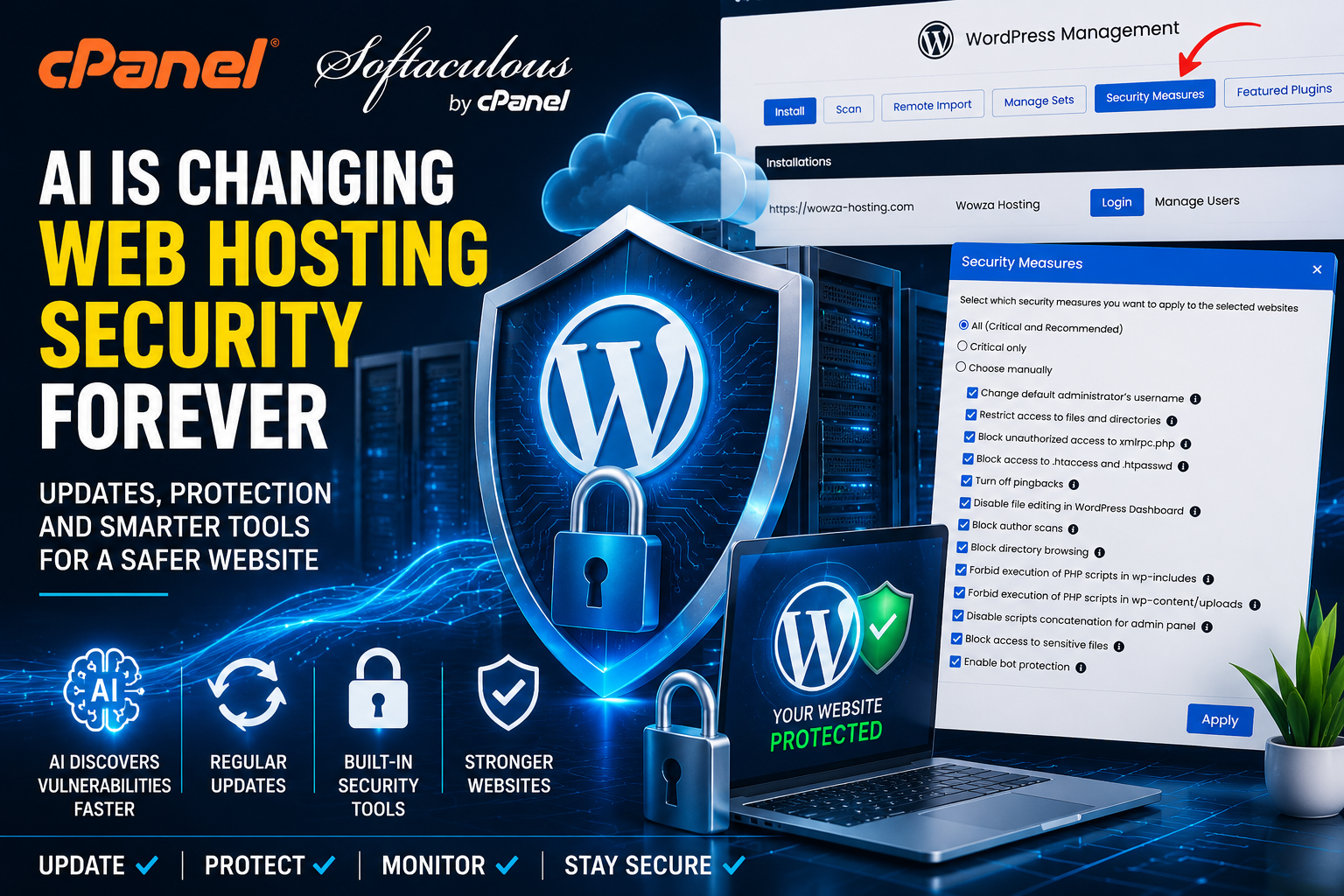
One of our favorite features is the WordPress Manager by Softaculous.
Inside WordPress Manager, there is a section called Security Measures that allows administrators to apply a collection of recommended security protections with just a few clicks.
These protections can help:
- Restrict access to sensitive files and directories
- Block unauthorized access to XML-RPC
- Disable file editing from the WordPress dashboard
- Prevent directory browsing
- Block author scans
- Protect .htaccess files
- Add bot protection
- Restrict execution of malicious scripts
Many of these settings are considered security best practices and can significantly reduce the attack surface of a WordPress website.

A few minutes of work can prevent major problems
To enable these protections:
- Log into cPanel.
- Open WordPress Manager by Softaculous.
- Select your website.
- Click Security Measures.
- Select “All (Critical and Recommended)”.
- Click Apply.
The process takes less than a minute.
While no security solution can guarantee complete protection, combining regular WordPress updates with the built-in Softaculous security measures provides a much stronger security foundation.
The reality is simple: the age of “install and forget” websites is over.
Artificial intelligence is transforming the way vulnerabilities are discovered. Hosting providers, software developers, and website owners must all adapt to this new reality.
The good news is that the tools already exist. Keeping your website secure no longer requires being a cybersecurity expert. It simply requires staying informed, applying updates regularly, and making use of the security features already available within your hosting account.